Advertisements
Let me be straight with you. Dishwashing isn’t glamorous work. It’s hot, it’s wet, your hands get pruney, and you’ll spend hours on your feet scrubbing plates while everyone else seems to be doing something more interesting. But here’s what it also is: an actual, legitimate way to get your foot in the door in America.
I’m not going to sell you a dream. I’m going to tell you the truth about dishwasher jobs with visa sponsorship in the USA. The real salaries, the actual companies hiring, what the work is truly like, and whether it’s worth it for you.
Why American Restaurants Are Hiring Foreign Dishwashers
The American restaurant industry has a problem. Nobody wants to wash dishes anymore.
Advertisements
Think about it. Would you rather serve tables and collect tips, or stand in the back scrubbing pots for minimum wage? Would you rather cook food, or clean the mess afterwards? Most Americans, especially young ones, choose anything but dishwashing if they have options.
This creates a massive labor shortage. Restaurants can’t function without clean dishes. Hotels need spotless kitchens. Resorts during summer season are desperate. And when American businesses can’t find American workers, they turn to foreign labor through visa sponsorship programs.
According to industry data, there are roughly 500,000 vacant dishwashing positions across the United States. That’s half a million jobs that American restaurants, hotels, and food service companies can’t fill. For you, that’s half a million potential opportunities.
The Visa That Actually Works: H-2B
Here’s the visa you’ll most likely use: H-2B.
The H-2B visa is for temporary, non agricultural workers. It’s designed exactly for jobs like dishwashing that are seasonal, peak load, or just plain hard to fill with local workers. For 2025, there are 66,000 regular H-2B visas available, plus an additional 64,716 supplemental visas, bringing the total to about 130,716 opportunities.
How H-2B Works:
Your employer sponsors you, not the other way around. You can’t just apply for an H-2B visa yourself. A U.S. restaurant, hotel, or food service company must want to hire you specifically and be willing to go through the paperwork to bring you over.
It’s temporary, typically valid for up to 9 months initially, extendable to a maximum of 3 years total. After that, you must return home for at least 3 months before you can apply for another H-2B visa.
The employer must prove they tried to hire Americans first and couldn’t find anyone. Given the shortage, this is usually easy to demonstrate.
You must intend to return to your home country eventually. This isn’t a path to a green card or permanent residence. It’s temporary work.
The Process Timeline:
The employer files for a Prevailing Wage Determination to prove they’ll pay you fairly (usually takes 6 to 8 weeks). They then file a Labor Certification with the Department of Labor showing they can’t find U.S. workers (another 4 to 6 weeks). Once approved, they file Form I-129 with USCIS to petition for you specifically (30 to 60 days). Finally, you apply for your H-2B visa at the U.S. embassy in your country, attend an interview, and if approved, receive your visa within 1 to 2 weeks.
Total timeline: 4 to 6 months from when the employer starts the process until you have your visa. Sometimes faster, sometimes slower depending on the time of year and where you’re from.
What You’ll Actually Earn
Let’s talk money because that’s probably why you’re reading this.
The Numbers:
According to multiple salary sources, the average dishwasher in America earns between $14 to $16 per hour. That works out to about $29,000 to $33,000 annually if you work full time.
ZipRecruiter reports the average dishwasher salary is $30,016 per year, which is $14.43 per hour. Indeed shows $15.51 per hour on average. Salary.com says $15 per hour or $31,826 annually. Glassdoor reports slightly higher at $18 per hour or $38,372 annually.
The truth is probably somewhere in the middle. Expect $14 to $16 per hour when you start, potentially rising to $17 to $18 per hour with experience and in higher cost cities.
What That Actually Means:
Let’s say you work 40 hours per week at $15 per hour. That’s $600 per week before taxes. After federal income tax, Social Security, and Medicare deductions (roughly 20 to 25% total), you’ll take home about $450 to $480 per week, or $1,800 to $1,920 per month.
Now subtract basic living expenses. Rent for a room in a shared apartment: $500 to $800 per month depending on location. Food if you cook at home: $300 to $400 per month. Transportation: $50 to $150 per month. Phone and miscellaneous: $100 to $150 per month.
Total expenses: roughly $1,000 to $1,500 per month in affordable areas, $1,500 to $2,500 in expensive cities.
So realistically, after covering basic living costs, you might have $300 to $900 left each month. That’s what you can save or send back home to family.
It’s not going to make you rich. But for many people from countries where $300 per month represents several months’ salary, that’s meaningful money.
Ways to Earn More:
Work overtime. Dishwashing often involves overtime, especially during busy seasons. Overtime is typically paid at 1.5 times your regular rate. If you’re earning $15 per hour normally, overtime pays $22.50 per hour.
Work night shifts or weekends. Many restaurants offer shift differentials, paying an extra $1 to $3 per hour for less desirable shifts.
Get a job in expensive cities. Dishwashers in places like San Francisco, Los Angeles, or New York earn $17 to $20 per hour, though living costs are also much higher.
Get promoted. Start as a dishwasher, prove you’re reliable and hardworking, and you might move up to prep cook, line cook, or kitchen supervisor roles that pay better.
Companies Actually Hiring Dishwashers with Visa Sponsorship
This is the most important section. Which employers are actually doing H-2B sponsorship for dishwashers?
Major Restaurant Chains:
Olive Garden (part of Darden Restaurants) regularly sponsors H-2B workers for dishwashing positions, especially in high volume locations. They’re one of the largest casual dining chains in America with hundreds of locations.
The Cheesecake Factory has a history of sponsoring foreign workers for kitchen support roles including dishwashers, particularly in areas facing labor shortages.
Cracker Barrel is known for hiring H-2B workers for various positions including dishwashing, especially in Southern states and tourist areas.
Yard House specializes in draft beer and American cuisine and actively hires diverse workforces including sponsored foreign dishwashers.
Taco Bell occasionally sponsors H-2B visas for dishwashers in high demand markets.
Hospitality Companies:
Marriott Hotels sponsors dishwashers for their hotel restaurants and catering operations, particularly at large properties and resorts.
Omni Hotels & Resorts actively uses H-2B sponsorship for seasonal dishwashing roles at resort properties.
Four Seasons Hotels hires foreign workers for various kitchen positions including dishwashing.
Grand Hotel in Mackinac Island, Michigan, and other seasonal resort properties regularly hire H-2B dishwashers for summer seasons.
Discovery Land Company operates luxury golf clubs and resorts that frequently sponsor H-2B workers for kitchen roles.
Food Service Management:
Aramark is a massive food service company serving hospitals, schools, sports venues, and corporate cafeterias nationwide. They regularly sponsor foreign workers for various positions including dishwashing.
Compass Group is another huge food service provider with contracts across the country that uses H-2B sponsorship.
How to Find Specific Openings:
Search Indeed.com for “H-2B dishwasher” or “dishwasher visa sponsorship.” Look on the Department of Labor’s official H-2B disclosure website where employers must list certified positions. Check individual company career websites, especially during hiring seasons (spring for summer positions, fall for winter positions). Contact specialized H-2B recruitment agencies that connect foreign workers with U.S. employers, though be cautious about fees (more on that later).
What the Job Actually Involves
You need to know what you’re signing up for. Dishwashing isn’t complicated, but it’s physically demanding.
Typical Dishwasher Duties:
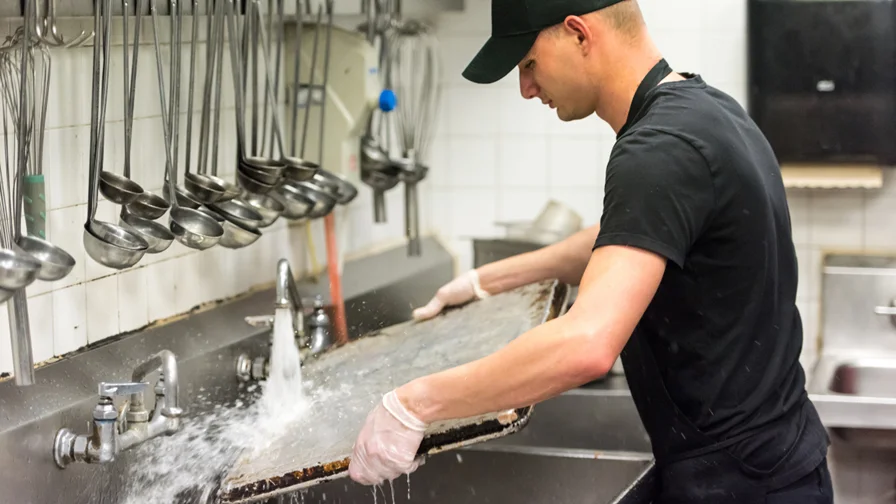
Operating industrial dishwashing machines. These aren’t like your home dishwasher. They’re large, hot, and fast. You load racks of dishes, push them through, and unload clean dishes on the other side.
Hand washing large pots, pans, and equipment that won’t fit in the machine. This is the hardest part. Some pots will be caked with burnt food. You’ll scrub until your arms ache.
Keeping the dish pit area clean and organized. You’re responsible for maintaining a sanitary workspace, mopping floors, taking out trash, and managing the flow of dirty dishes coming in and clean dishes going out.
Assisting with basic kitchen cleaning tasks like wiping down prep stations, cleaning equipment, and helping close the kitchen at the end of shifts.
Sometimes helping with very basic food prep in between dishwashing tasks, though this varies by restaurant.
The Reality:
You’ll be on your feet for 8 to 12 hour shifts. You’ll work in heat and humidity from dishwashing machines and steam. Your clothes will get wet and dirty. The work is repetitive. Rush periods (lunch and dinner times) are chaotic with dishes piling up faster than you can clean them. You’ll deal with gross stuff. Food scraps, grease, sometimes finding things in dirty dishes you’d rather not think about.
But here’s the thing: it doesn’t require English fluency, advanced education, or special skills. If you’re physically capable and willing to work hard, you can do this job.
The Actual Application Process
So how do you actually get one of these jobs?
Step 1: Make Sure You Qualify
You need to be at least 18 years old. You need a valid passport from your country. You need to be physically capable of the work (standing long hours, lifting heavy items up to 50 pounds, working in heat and wet conditions). You should have at least basic English communication skills, though it’s not always strictly required.
Step 2: Find Employers Hiring
Use the job search methods I mentioned earlier. Apply directly through company websites when possible. Respond to legitimate job postings on Indeed or other job boards that specifically mention visa sponsorship.
Step 3: Apply Smart
Create a simple resume highlighting any restaurant, kitchen, or cleaning experience you have. Even if you’ve never been a dishwasher professionally, include anything relevant: working in a family restaurant, helping in a canteen, food service in your home country, or even just emphasizing that you’re a hard worker and quick learner.
Write a brief cover letter (doesn’t need to be fancy) explaining that you’re seeking a dishwasher position with H-2B visa sponsorship, you’re willing to work hard, you understand the physical nature of the job, and you’re committed to the full contract period.
Apply to many positions, not just one or two. Response rates are low. You might apply to 30 jobs and hear back from 3. That’s normal.
Step 4: Interview
If an employer is interested, they’ll usually do a phone or video interview first. Be honest about your experience. Don’t lie and say you’re an expert dishwasher if you’ve never done it. They know it’s not rocket science and they’re more concerned about whether you’re reliable and willing to work.
Show enthusiasm for the opportunity. Employers are investing time and money in sponsoring you. They want to know you’re committed and won’t quit after two weeks.
Ask practical questions about housing (some employers provide it, others don’t), work schedule, how long the contract is, and when they expect you to start.
Step 5: Let the Employer Handle the Visa
Once you’re offered a position, the employer takes over the visa process. Your job is to provide all documents they request promptly and accurately.
They’ll likely ask for passport copies, proof of any prior experience or education, possibly reference letters from previous employers, police clearance certificates from your home country, and medical examination results from approved physicians.
Keep in close contact. Respond quickly to emails and requests. The process can stall if you’re slow to provide documents.
Step 6: Visa Interview
Eventually you’ll be scheduled for a visa interview at the U.S. embassy or consulate in your country. This is your chance to prove you’re a legitimate applicant.
Bring all required documents neatly organized. Dress presentably (not fancy, just clean and neat). Be honest in your interview. If the consular officer asks why you want to wash dishes in America, don’t make up stories. Say you want the opportunity to earn in U.S. dollars, gain work experience, and that you understand it’s temporary and you’ll return home when the contract ends.
If approved, you’ll typically receive your visa within a week or two.
The Challenges Nobody Talks About
Before you get too excited, let’s address the difficulties you’ll actually face.
The Work Is Hard:
I already mentioned this, but it bears repeating. Dishwashing is physically exhausting. After your first week, your feet will hurt, your back will ache, and you’ll be more tired than you’ve ever been. Many people quit within the first month because they can’t handle it.
Loneliness Is Real:
You’ll be in a foreign country, possibly not speaking great English, working long hours, and potentially not knowing anyone. Homesickness is common, especially in the first few months. If you’re not mentally prepared for this, it will be very difficult.
You’re Temporary:
Remember, H-2B is not a path to permanent residence. After your maximum 3 years, you must leave. If you’re hoping this leads to a green card, you’ll likely be disappointed. Some dishwashers eventually find other pathways (marrying an American, transitioning to student visas, finding employers willing to sponsor permanent residence), but that’s not the norm.
Living Costs Might Surprise You:
America is expensive. What seemed like good money when you were in your home country might not feel like much when you’re paying American prices for everything. Budget carefully and have realistic expectations.
You Might Be Exploited:
Some employers, especially smaller ones, try to take advantage of foreign workers. They might not pay overtime properly, create poor working conditions, or make threats about your visa status if you complain. Know your rights and don’t be afraid to report violations to the Department of Labor.
Scams to Avoid
Unfortunately, where there’s demand, there are scammers.
Never Pay for a Job:
Legitimate U.S. employers do not charge workers for job offers or visa sponsorship. It’s actually illegal for employers to require workers to pay recruitment fees under H-2B rules. If someone asks you to pay $1,000, $2,000, or any amount for a “guaranteed dishwasher job with visa,” it’s a scam.
Verify the Employer:
Before sending any documents or personal information, verify the company actually exists. Check their website, look for reviews, search for their business registration. Call the restaurant or hotel directly using publicly listed numbers to confirm they’re hiring.
Be Suspicious of Guarantees:
No one can guarantee visa approval. Even with a legitimate job offer, the U.S. government makes the final decision on your visa. Anyone promising 100% guaranteed approval is lying.
Watch for Fake Recruitment Agencies:
Some “agencies” claim to place workers in U.S. dishwashing jobs. While some legitimate recruitment firms exist, many are fraudulent. They’ll take your money and disappear. Or they’ll send fake job offers that fall apart when you try to get your visa.
Use Official Resources:
Apply directly through company websites when possible. Check the Department of Labor’s official H-2B job listings. Use well known job boards like Indeed. Be extremely cautious about opportunities that come through Facebook, WhatsApp, or other informal channels.
Is It Worth It?
That’s the question only you can answer.
This Might Be Worth It If:
You’re from a country where $300 to $500 per month in savings represents significant money. You’re young, physically fit, and can handle demanding work. You have specific financial goals (save for education, build a house, support family) that U.S. wages can help you achieve faster. You view this as temporary work to gain U.S. experience and improve your English. You’re mentally prepared for the challenges of living abroad temporarily.
This Probably Isn’t Worth It If:
You’re looking for easy money. Dishwashing is hard work. You expect to get rich. You won’t. You want a path to permanent U.S. residence. H-2B doesn’t provide that. You can’t handle being away from family for extended periods. You’re not physically capable of standing 8 to 12 hours and doing repetitive, demanding work.
The Bottom Line
Dishwasher jobs with H-2B visa sponsorship in the USA are real opportunities. They’re not scams, they’re not miracles, and they’re not going to change your life overnight. They’re hard, honest work that pays honest wages in U.S. dollars.
For some people, particularly from countries with lower wages and fewer opportunities, spending a year or two washing dishes in America makes perfect sense. You can save meaningful money, improve your English, gain work experience, and maybe even figure out other opportunities while you’re there.
For others, the physical demands, loneliness, and temporary nature make it not worth the hassle.
Only you know which category you fall into.
If you decide to pursue this, go in with your eyes open. Understand the realities, avoid the scams, work with legitimate employers, and have realistic expectations about what you’ll earn and experience.
The American restaurant industry genuinely needs dishwashers. The visas are real. The jobs exist. Whether one of them is right for you is something only you can decide.
Good luck.
Thank you so much for reading. We will appreciate it if you share this with your loved ones.
Advertisements